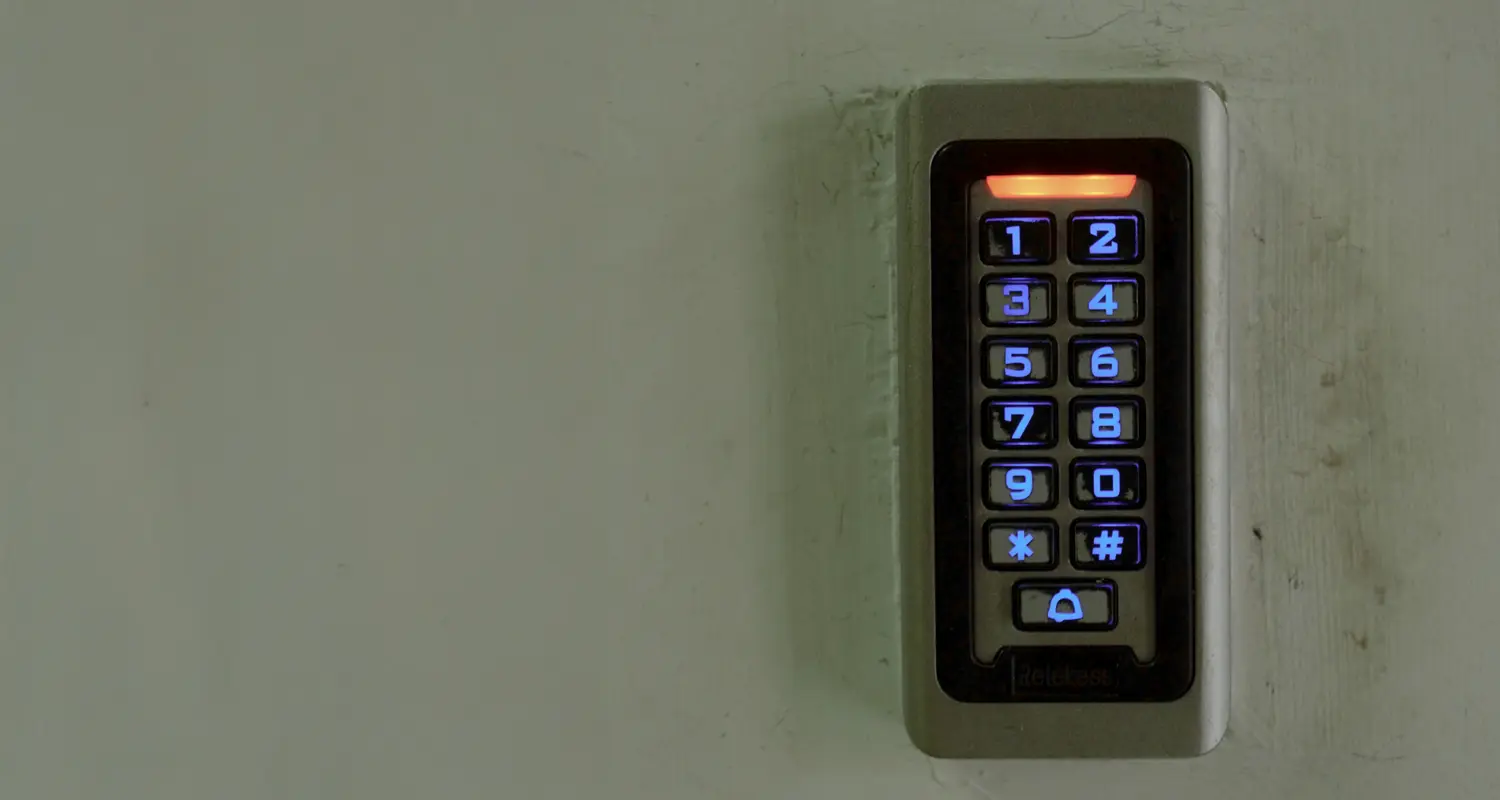
Every business controls access in one way or another.
For decades, the answer was simple. A key. A swipe card. A PIN code.
They all served the same purpose: allowing authorised people into a building while keeping everyone else out.
For many organisations, PIN codes remain an effective and familiar way of controlling access. They are simple to use, relatively inexpensive to implement and have formed part of commercial security for many years.
However, as businesses place greater emphasis on accountability, operational visibility and protecting sensitive areas, the question is changing.
Rather than simply asking whether someone knows the code, organisations increasingly want to know whether the person entering is actually the individual who has been authorised to do so.
That shift is one of the reasons biometric access control, including facial recognition technology, is becoming increasingly common across commercial buildings, industrial facilities and security sensitive environments.
The challenge with traditional PIN codes
PIN codes have many advantages, but they also rely on one important assumption.
That the person entering the code is the person who should be using it.
In practice, that is not always the case.
Codes are often shared between colleagues for convenience. Contractors may continue using the same access code after work has been completed, while temporary codes created for visitors can remain active far longer than intended.
None of these situations necessarily result from poor security practices. They are simply examples of how everyday habits can gradually reduce the effectiveness of a system over time.
The issue is not whether the correct code has been entered.
It is whether the person entering it is genuinely authorised to be there.
Verifying identity instead of validating a number
Facial recognition takes a different approach.
Rather than verifying something a person knows, it verifies who that person is.
That distinction fundamentally changes the way access control operates.
Unlike a PIN code, a face cannot be casually shared with another individual, written on a whiteboard or passed to a contractor over the phone. The technology is designed to recognise authorised users, giving organisations greater confidence that access is being granted to the correct individual.
For businesses where accountability is important, this represents a significant step forward.
Access is linked to a person rather than simply a credential.
Better security also creates better accountability
Modern access control is no longer simply about unlocking doors.
It is also about understanding who entered a building, when they arrived and, where appropriate, when they left.
That information supports day to day operations just as much as physical security.
Whether reviewing building access, investigating an incident or understanding activity outside normal working hours, accurate access records provide organisations with valuable operational insight.
As governance, compliance and security expectations continue to evolve, that level of accountability is becoming increasingly important across many sectors.
Why Copeland upgraded its own head office
At Copeland Group Services, we recently upgraded access control at our own head office, replacing a traditional coded entry system with Dahua facial recognition technology.
The decision reflected the same advice we increasingly provide to our clients.
Security should evolve alongside the way organisations operate.
As businesses grow, teams change and operational requirements become more complex, it is important to regularly review whether existing security measures continue to provide the level of protection, accountability and operational confidence required.
For us, facial recognition represented the next logical step.
Access control works best as part of a wider strategy
No access control solution should ever be viewed in isolation.
The strongest security strategies combine multiple layers of protection that complement one another.
Facial recognition provides confidence that authorised individuals are entering the building. Virtual Guard extends visibility across the site through monitored CCTV. Professional lock and unlock services ensure premises are consistently secured outside working hours, while keyholding, alarm response and mobile patrols provide additional reassurance when sites are unoccupied.
Each service performs a different role.
Together, they create a more resilient security strategy that supports both operational efficiency and physical protection.
Looking beyond the PIN code
PIN codes remain an effective solution for many organisations and will continue to play an important role in business security.
However, as businesses increasingly focus on accountability, operational visibility and reducing unnecessary risk, facial recognition is becoming an attractive alternative.
The conversation is no longer simply about whether a code unlocks a door.
It is about whether organisations can be confident that the right person is walking through it.
At Copeland Group Services, we believe effective access control should combine intelligent technology with practical operational thinking. Whether that’s through Virtual Guard, modern access control, TrakNet Technologies, manned guarding, professional lock and unlock services, mobile patrols, keyholding and alarm response or EcoWatch Rapid Deployment CCTV, every layer contributes towards creating a safer, smarter and more resilient security strategy.
If you’d like to discuss how modern access control could support your organisation, we’d be pleased to help.
Photo by vuk burgic on Unsplash