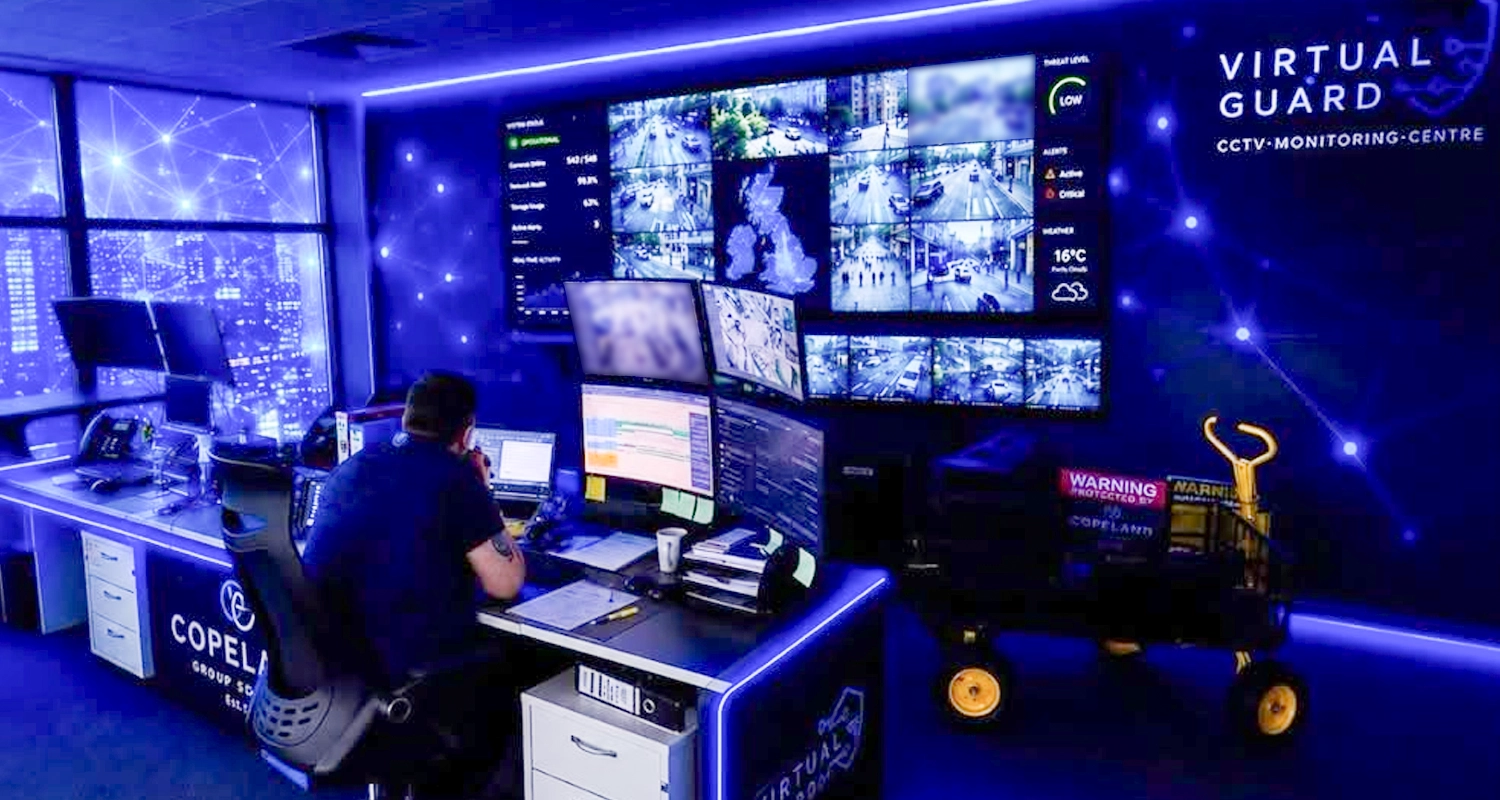
CCTV has become such a familiar part of commercial security that its presence can sometimes provide a false sense of reassurance.
Cameras cover entrances, car parks, loading areas and building perimeters. Signs make visitors aware that CCTV is in operation and footage is recorded should it ever be required.
But there is an important difference between recording an incident and responding to one.
If nobody is monitoring the cameras when suspicious activity takes place, CCTV may provide valuable evidence afterwards. What it cannot necessarily do is influence what happens while the incident is unfolding.
That distinction is at the heart of monitored CCTV and Copeland Group Services’ Virtual Guard approach.
Recording an incident is not the same as preventing one
Traditional CCTV performs an important role.
Recorded footage can help organisations understand what happened, establish timings and provide evidence following theft, vandalism, unauthorised access or other incidents.
The problem is that by the time somebody watches the footage, the damage may already have been done.
A person entering a restricted area at 2am may be clearly visible on several cameras. If those cameras are only recording, however, nobody may become aware of the activity until employees arrive the following morning.
At that point, CCTV becomes part of the investigation rather than part of the response.
Monitoring changes that relationship.
Instead of asking “What happened last night?”, organisations have the opportunity to identify and respond to suspicious activity while it is taking place.
The value is in what happens next
A camera detecting activity is only the beginning of a security process.
What matters is what happens with that information.
When CCTV is professionally monitored, activity can be assessed to determine whether it is expected or potentially suspicious. Depending on the circumstances and agreed procedures, an appropriate response can then follow.
This is an important distinction because not every movement captured by a camera represents a threat. An employee working late, an authorised contractor or a scheduled delivery may all generate activity outside normal hours.
Effective monitoring therefore requires more than simply seeing movement on a screen.
It requires context.
That is where trained security professionals remain essential. Technology provides visibility, but people use experience and agreed site procedures to understand what that activity means and determine what should happen next.
CCTV becomes more valuable when nobody is there
Many commercial sites are at their most vulnerable precisely when the fewest people are present.
During the working day, employees naturally provide additional eyes and ears. Unusual behaviour is more likely to be noticed, doors are regularly used and activity around the premises is easier to identify.
At night, during weekends or over extended shutdown periods, that changes.
An industrial estate that is busy at 2pm can be almost completely empty twelve hours later. Construction sites may contain valuable plant and materials but have nobody physically present for long periods. Offices, warehouses and retail premises can face similar periods of vulnerability.
Monitored CCTV allows visibility to continue when the workforce has gone home.
This does not remove the value of physical security. Instead, it provides another layer that can work alongside manned guarding, mobile patrols, keyholding and other services.
Technology and people work together
Modern CCTV technology is increasingly capable of helping operators focus their attention where it is needed.
Intelligent systems can support the identification of activity across monitored areas, reducing the reliance on somebody continuously watching every camera feed.
But identifying activity and understanding it are different things.
A system might identify movement within a defined area. An experienced operator can assess the wider circumstances, consider the site’s operating procedures and determine whether further action is appropriate.
This principle sits behind Copeland’s wider approach to technology.
Virtual Guard brings together intelligent security technology and professional monitoring, while developments such as T.A.L.I.U.M., the Tactical, Adaptive, Logical, Intelligent, Unified Manager, are designed to support operational teams with better access to information.
The objective is not to remove people from security.
It is to give them greater visibility and better tools with which to make informed decisions.
Monitoring can also support physical security
Monitored CCTV should not be viewed as an alternative to security officers.
In many environments, the strongest approach combines the two.
A manned guard provides an immediate physical presence, professional judgement and visible deterrence. Mobile patrols provide physical checks across sites without requiring a permanent officer at every location. CCTV monitoring provides visibility between those patrols and across areas that cannot all be physically observed simultaneously.
When these services work together, information can help focus physical security resources where attention is actually required.
That is the principle behind blended security.
Rather than asking whether a business needs CCTV or security officers, the better question is how the right combination of services can address the risks faced by that particular site.
Permanent and temporary monitoring
The requirement for monitored CCTV is not limited to permanent commercial premises.
Construction projects, vacant buildings and temporary sites often present particularly difficult security challenges because the environment changes over time and permanent infrastructure may not yet exist.
This is where EcoWatch Rapid Deployment CCTV, as part of the wider Virtual Guard offering, can provide a flexible option for temporary monitoring requirements.
For established commercial and industrial premises, permanent CCTV systems can provide continuous coverage of key areas as part of a longer term security strategy.
The technology may differ, but the underlying principle remains the same.
Visibility becomes significantly more useful when there is a clear process for acting upon what is seen.
Moving CCTV from evidence to active security
There will always be value in recorded CCTV.
If an incident occurs, good quality footage can provide important evidence and help businesses understand exactly what happened.
But organisations should also consider what they expect their CCTV system to achieve.
If its purpose is purely to provide a record, recording may be sufficient.
If the objective is to identify suspicious activity earlier and support an appropriate response, monitoring adds an entirely different capability.
At Copeland Group Services, Virtual Guard forms part of a wider blended security strategy incorporating manned guarding, mobile patrols, professional lock and unlock services, keyholding and alarm response, access control, EcoWatch Rapid Deployment CCTV and TrakNet Technologies.
Because CCTV can show you what happened.
Monitoring creates the opportunity to do something about it.
If you would like to discuss whether monitored CCTV could strengthen the security of your premises, contact Copeland Group Services today.