Managing security at one location can be complicated.
Managing it across ten, twenty or a hundred locations creates an entirely different challenge.
Multi site organisations may operate offices, warehouses, retail premises, industrial facilities or other locations spread across different towns and regions. Each site has its own people, routines and risks, yet the organisation still needs confidence that the same security standards are being applied everywhere.
That is often where the difficulty begins.
Over time, individual sites develop their own ways of doing things. One location may have strong opening and closing procedures, while another relies on whichever employee happens to arrive first. CCTV may be actively monitored at one site but used purely for recording at another. Keys, access permissions and alarm procedures can gradually become dependent on local knowledge rather than a consistent organisational standard.
None of these differences necessarily represents poor management.
They are often simply what happens when businesses grow.
The security challenge is making sure growth does not create gaps.
Local flexibility can gradually become inconsistency
Every site is different, and security should reflect that.
A city centre office does not necessarily face the same risks as an industrial unit on an isolated business park. Different operating hours, staffing levels and surrounding environments mean some variation in security provision is both sensible and necessary.
The problem arises when variation becomes inconsistency.
If individual sites develop completely different procedures, central teams can find it increasingly difficult to understand how security is actually being managed across the organisation.
Who is responsible for locking each building?
Who currently holds keys?
Which employees still have access?
What happens if an alarm activates overnight?
Who verifies that agreed security checks have actually taken place?
For a single location, these questions are relatively straightforward. Across a large property portfolio, they can quickly become much harder to answer.
Small differences create larger organisational risks
Security failures are often caused by relatively ordinary events rather than sophisticated attacks.
A door is not secured correctly. An old access credential remains active. A key is not returned when someone leaves. An alarm procedure is understood differently at two locations.
Individually, these issues can appear minor.
Across dozens of sites, however, small inconsistencies begin to multiply.
This is why multi site security is as much about process as physical protection. Businesses need enough flexibility to respond to the risks of each location while maintaining clear minimum standards across the organisation.
Without that consistency, senior management may believe a particular security process exists everywhere when the reality on the ground is very different.
Opening and closing is a good example
The beginning and end of the working day illustrates the challenge particularly well.
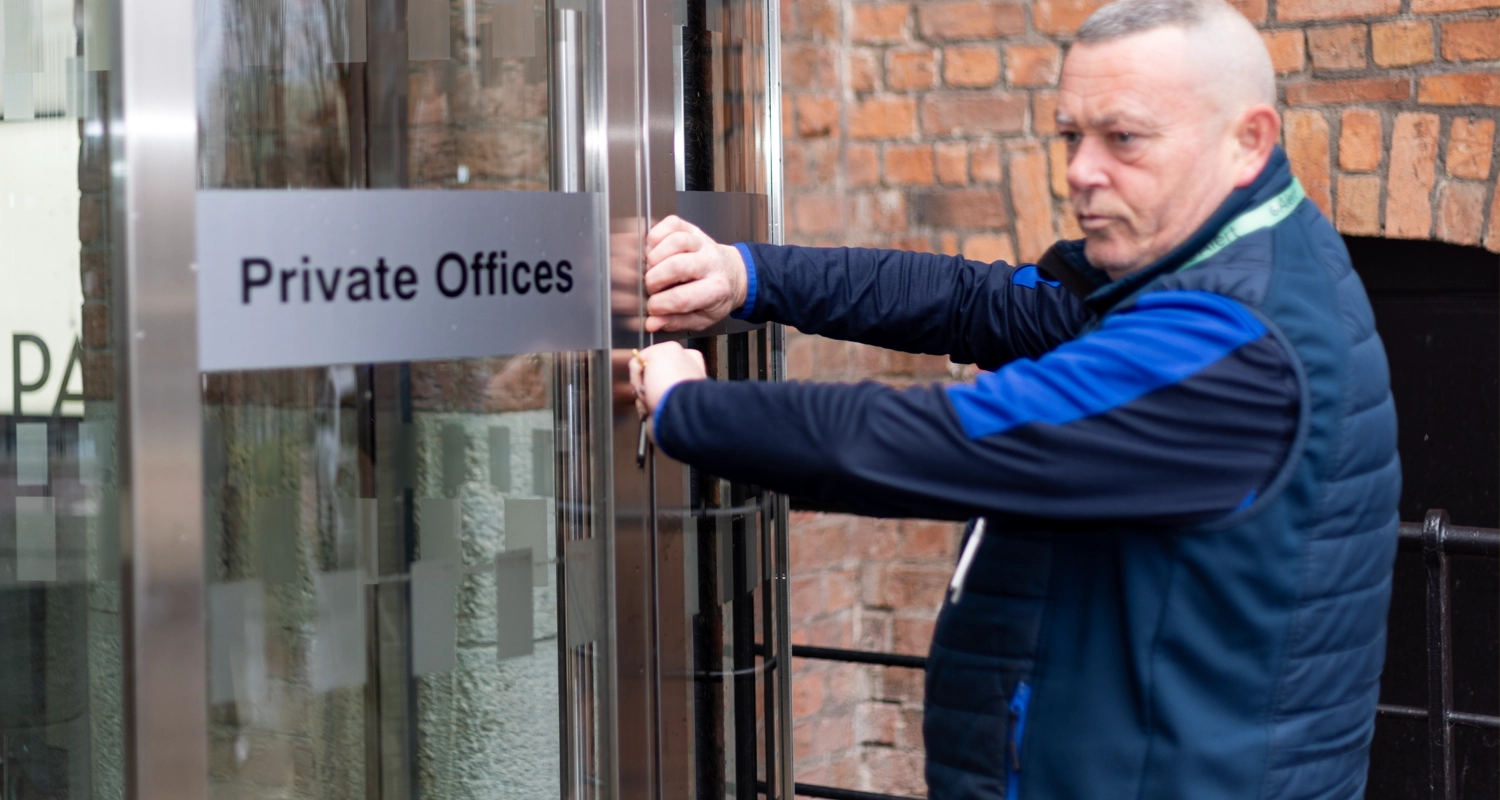
One office may have a professional lock and unlock service, meaning trained security personnel follow agreed procedures each morning and evening.
At another site, the responsibility may sit with a local manager.
A third location might have several employees holding keys because different people need to open the premises depending on shift patterns.
All three arrangements can work.
The difficulty is ensuring the organisation understands the risks associated with each approach and that responsibilities are clearly defined.
Professionalising opening and closing across appropriate locations can reduce reliance on individual employees while creating greater consistency around how buildings are secured.
It also helps reduce the personal safety risks associated with staff arriving at empty premises or leaving alone after dark.
Technology can create visibility across multiple locations
One of the biggest changes in multi site security has been the ability to create greater central visibility.
Historically, individual locations often operated almost independently. Problems might only become visible to senior management after an incident had occurred.
Modern monitoring and security technology can change that relationship.
Through Virtual Guard, CCTV monitoring can provide oversight across multiple locations without requiring a permanent physical security presence at every site. Access control can provide a more structured approach to managing who is authorised to enter premises, while centralised operational information can help organisations develop a clearer understanding of security activity across their estate.
Copeland’s continued development of TrakNet Technologies and T.A.L.I.U.M., the Tactical, Adaptive, Logical, Intelligent, Unified Manager, reflects the same principle: giving security professionals and organisations better access to information that supports more informed operational decisions.
Technology does not remove the individual requirements of each site.
It helps organisations see the bigger picture.
Consistency does not mean identical security everywhere
This distinction is important.
A consistent security strategy does not mean installing exactly the same equipment or providing exactly the same services at every location.
That can be just as ineffective as having no central strategy at all.
Instead, consistency means having a common approach to assessing risk, defining responsibilities, managing access and responding to incidents, while allowing the actual security measures to reflect the needs of each site.
A high risk distribution facility may justify manned guarding and extensive monitored CCTV. A smaller office might be better supported through professional lock and unlock, access control, keyholding and alarm response.
The services differ.
The standard behind them does not.
Physical presence still matters
Centralised monitoring should not be confused with removing physical security from multi site operations.
For some locations, manned guarding remains the most appropriate solution because the site requires a permanent professional presence. Elsewhere, mobile patrols can provide physical checks and visible deterrence across a wider geographical area.
The advantage of a blended approach is that these services can be used according to the needs of each location rather than applying a single security model everywhere.
Visibility helps organisations understand where attention is required.
Physical security provides presence and response where it adds the greatest value.
Together, they allow multi site organisations to create consistency without sacrificing flexibility.
Security needs to scale with the business
Businesses rarely become multi site organisations overnight.
A second office opens. Another warehouse is acquired. A regional operation expands nationally. Over time, a security model originally designed around a handful of locations may be expected to support a much larger estate.
That is the point at which informal processes can begin to struggle.
The answer is not necessarily more security.
It is greater structure.
Clear procedures, defined responsibilities, appropriate technology and professional security services allow organisations to maintain standards as their footprint grows.
At Copeland Group Services, our blended approach can combine manned guarding, Virtual Guard, mobile patrols, professional lock and unlock services, keyholding and alarm response, access control, EcoWatch Rapid Deployment CCTV, TrakNet Technologies and T.A.L.I.U.M. according to the requirements of individual locations and the wider organisation.
Because effective multi site security is not about making every building the same.
It is about making sure every building is protected to the right standard.
If your organisation is reviewing security across multiple sites, contact Copeland Group Services to discuss how a consistent, blended security strategy could support your estate.