Most businesses do not build their security systems all at once.
CCTV may have been installed several years ago. Access control is introduced when the business expands. Monitoring is added following a change in operating hours, while physical security services develop separately as the organisation grows.
Individually, each measure may work perfectly well.
The problem is that security can gradually become a collection of separate systems rather than one coordinated strategy.
Modern security is increasingly about bringing those elements together. CCTV provides visibility, access control helps manage who should be there, monitoring provides oversight when people are not physically present, and professional security teams provide the judgement and response that technology alone cannot deliver.
That integrated approach sits at the heart of Copeland Group Services’ Virtual Guard philosophy.
CCTV provides visibility, but visibility is only the beginning
CCTV remains one of the most important components of commercial security.
It can provide oversight across entrances, car parks, loading areas, perimeters and other vulnerable locations, allowing organisations to understand activity across areas that cannot all be physically observed at the same time.
But a camera on its own can only provide information.
If footage is simply recorded, its greatest value may come after an incident has occurred. Professional monitoring changes that relationship by creating an opportunity for activity to be assessed while it is taking place.
That makes CCTV part of an active security process rather than simply a source of evidence.
The next question is whether the activity being observed is legitimate.
That is where access control becomes particularly valuable.
Access control adds identity to visibility
Seeing someone entering a building tells you something is happening.
Understanding whether they are authorised to be there provides context.
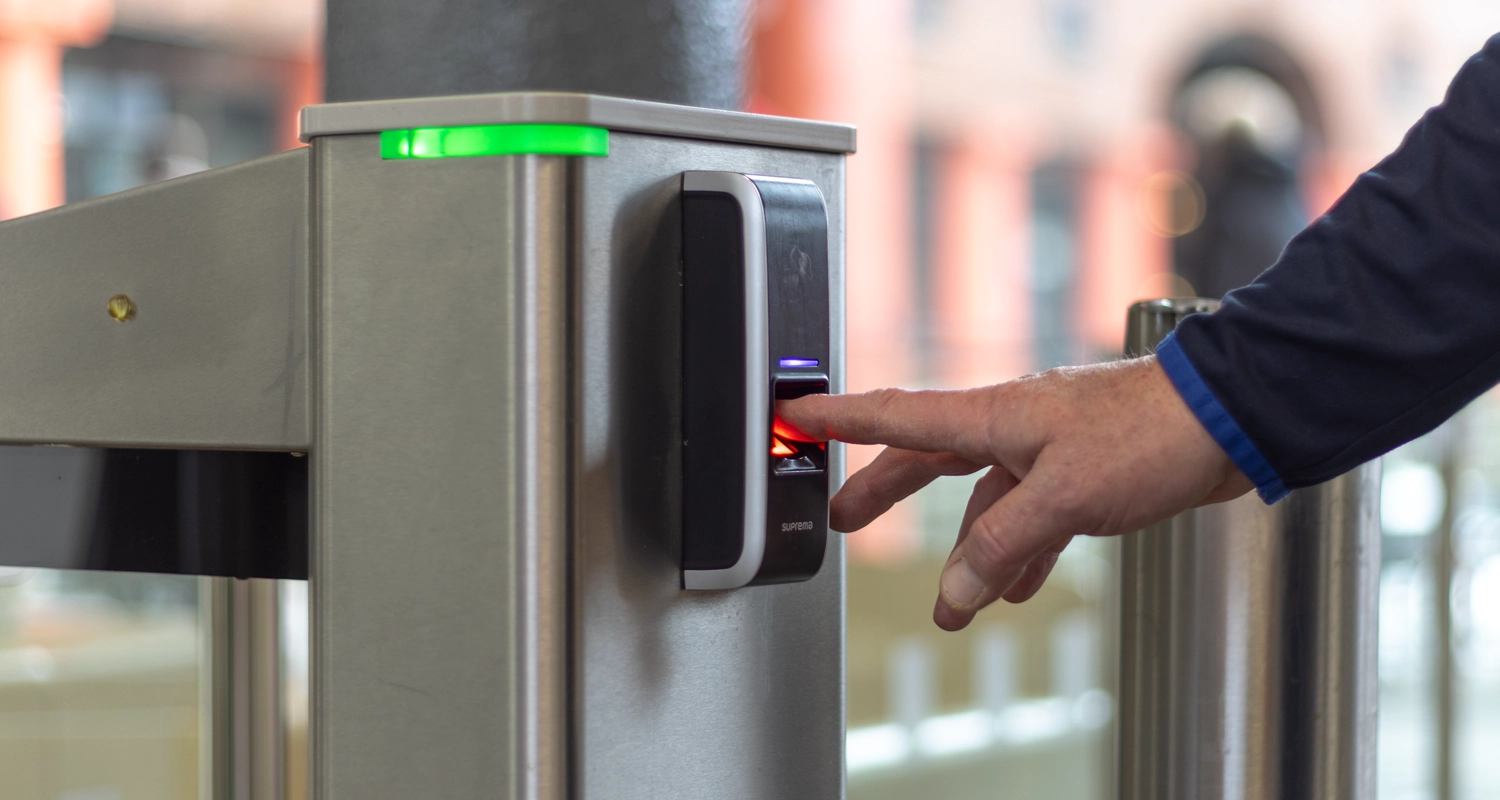
Traditional access control might use keys, cards or PIN codes to manage entry. More advanced systems can use biometric technologies such as facial recognition to verify the individual rather than relying solely on something they possess or know.
Copeland has adopted this approach at its own head office, upgrading from a coded door entry system to Dahua facial recognition technology.
The benefit extends beyond controlling whether a door opens. Modern access control can create clearer records around site access and help organisations maintain greater oversight of who is authorised to enter particular areas.
When access information and CCTV form part of the same wider security strategy, the organisation gains a more complete picture of what is happening around its premises.
Monitoring turns information into action
More security information is only useful if there is a clear process for dealing with it.
Modern systems can generate significant amounts of data. Cameras capture activity, access control records entry and other security systems generate alerts when something falls outside expected parameters.
Without appropriate oversight, those systems can remain separate streams of information.
Professional monitoring provides the human element that connects them.
An experienced operator can consider what is being seen alongside the expected activity at a site and determine whether something requires further attention. Instead of treating every alert as an incident, information can be assessed within its wider context and handled according to agreed procedures.
This is an important part of the Virtual Guard approach. Technology provides greater visibility, but trained security professionals remain responsible for understanding what that information means and determining the appropriate response.
AI can help make information more useful
As security systems become more sophisticated, the challenge is increasingly shifting from collecting information to making sense of it.
Artificial intelligence can support that process.
Copeland’s T.A.L.I.U.M., the Tactical, Adaptive, Logical, Intelligent, Unified Manager, has been developed as an AI enabled operational assistant designed to support experienced security professionals.
Its role is not to replace the people operating security systems. Instead, it helps information to be managed more effectively, supports the identification of patterns and reduces some of the administrative burden associated with modern security operations.
That distinction is important.
The objective of integrated security is not to automate people out of the process. It is to make sure the people responsible for security have the clearest possible operational picture when making decisions.
Integration strengthens physical security too
Bringing CCTV, access control and monitoring together does not remove the need for physical security.
In many environments, it makes physical security more effective.
A manned security officer provides a visible deterrent, professional judgement and immediate physical presence. Mobile patrols provide checks and response across locations where permanent guarding may not be required. Keyholding and alarm response provide professional attendance when incidents occur outside normal working hours.
Greater visibility and better information can support each of those services.
Rather than a patrol or officer responding with little understanding of what has happened, information gathered through monitoring can provide useful context before they attend.
The technology and physical security therefore become part of the same process rather than separate solutions.
Different sites still need different solutions
Integration does not mean every organisation needs every available security technology.
A corporate office, construction site, warehouse and multi site retail operation can have very different requirements.
Permanent CCTV and biometric access control may make sense for an established commercial building, while a changing construction environment may benefit from EcoWatch Rapid Deployment CCTV alongside controlled access, mobile patrols or manned guarding.
The important principle is that each element should have a defined role within the wider strategy.
Adding another camera or access system does not automatically make a site more secure. The value comes from understanding what risk it addresses, how the information it generates will be used and what happens when something requires action.
Moving from individual products to a security strategy
It is easy for organisations to think about security in terms of individual products.
Do we need more cameras? Should we upgrade the door access system? Do we need monitoring? Should we introduce mobile patrols?
Those are useful questions, but they should follow a more important one.
What are we trying to protect, and how should the different layers of security work together to achieve it?
That is the principle behind Virtual Guard and Copeland’s wider blended security approach.
By combining Virtual Guard, permanent CCTV, access control, EcoWatch Rapid Deployment CCTV, T.A.L.I.U.M., manned guarding, mobile patrols, professional lock and unlock services, keyholding and alarm response and TrakNet Technologies, organisations can create a security strategy in which technology, information and professional security teams complement one another.
Because the strongest security does not come from having the most systems.
It comes from making the right systems work together.
If you are reviewing CCTV, access control or monitoring across your organisation, contact Copeland Group Services to discuss how an integrated security strategy could support your premises.