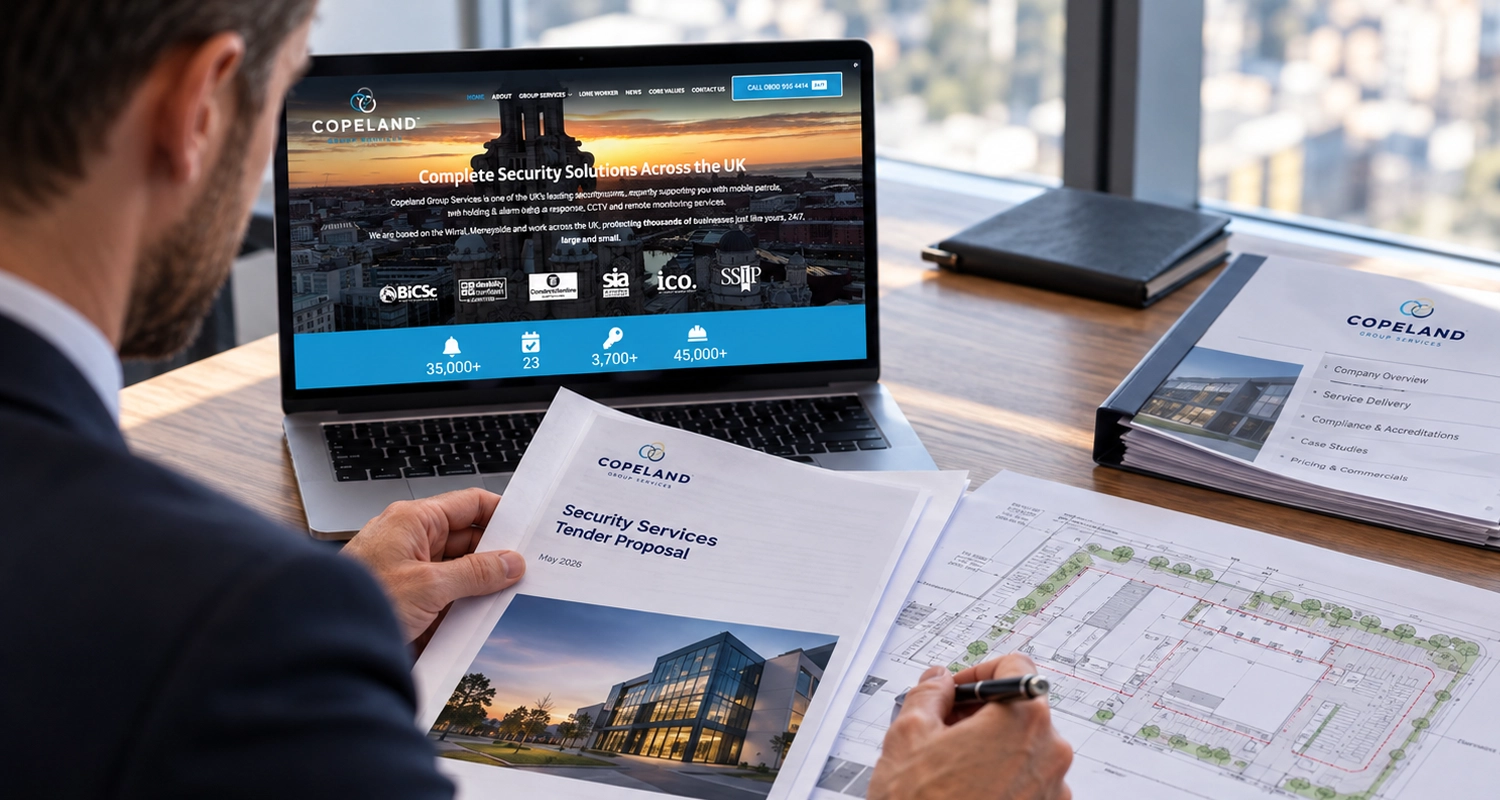
Choosing a security company can look straightforward on paper. Define the service, request several quotations and compare the prices.
The difficulty is that two proposals offering the same number of security hours can represent very different services.
For procurement teams, the challenge is therefore not simply finding out what a provider costs. It is understanding what sits behind the quotation and whether the company has the people, systems and operational resilience to deliver what has been promised.
What actually sits behind the service?
Whether you are buying manned guarding, mobile patrols, keyholding or CCTV monitoring, it is worth looking beyond the visible part of the service.
A security officer on site needs management and support behind them. A mobile patrol needs a control room and clear response procedures. Monitored CCTV is only useful if somebody understands what they are seeing and knows what should happen next.
Procurement should therefore understand how the provider operates when circumstances are not routine. What happens if the regular officer is unavailable? Who supports staff working overnight? How are incidents escalated and how does the provider maintain continuity?
Those questions often reveal far more about a security company than the headline hourly rate.
Ask for evidence, not reassurance
Professional security companies operate within an environment of standards, accreditation and regulation. Procurement teams should understand which credentials are relevant to the services they are buying and ask providers to demonstrate them.
At Copeland Group Services, this includes SIA Approved Contractor Scheme status, NSI inspection and management systems certified to standards including ISO 9001, ISO 14001, ISO 18788, ISO 22301, ISO 27001 and ISO 45001, alongside relevant British Standards across our security operations.
The important point for a buyer is not simply seeing logos on a proposal. It is understanding what those standards relate to and whether the provider can demonstrate that the processes behind them are genuinely embedded in the service.
The same principle applies to screening, training and reporting. A confident answer is useful. Evidence is better.
How will the provider fit your site?
A good security company should want to understand the environment before recommending a solution.
A construction project does not have the same risks as a corporate office. A distribution centre operating throughout the night requires something different from a building that is empty after 6pm.
That is why procurement conversations should go beyond asking how many officers or cameras are required. The better discussion is about what needs protecting, when the risks are greatest and how different security measures can work together.
For some sites, manned guarding will provide the right permanent presence. Elsewhere, Virtual Guard, mobile patrols, keyholding, access control or professional lock and unlock may provide a more appropriate combination.
The strongest proposal should explain why those services have been recommended rather than simply provide a menu of options.
What happens when something goes wrong?
This is probably the most useful question procurement can ask.
Security is easy to describe when everything is quiet. The quality of the provider becomes much clearer when an alarm activates at 2am, an officer identifies suspicious activity or somebody needs to attend the site unexpectedly.
Who receives the information? Who makes the decision? Who attends? How is the client kept informed?
Copeland’s 24 hour UK control room, supported by technologies including TrakNet Technologies and T.A.L.I.U.M., forms part of the operational structure behind our security services. It connects monitoring, officers and response teams so that individual services do not operate in isolation.
That wider infrastructure is an important part of what procurement is actually buying.
Choosing on value rather than price alone
Price matters, particularly on long term security contracts, but the lowest figure does not necessarily represent the lowest risk or the best value.
When choosing a security company, procurement should understand the people, processes, accreditation, management and operational support behind the proposal as carefully as the cost.
At Copeland Group Services, our blended approach brings together manned guarding, Virtual Guard, mobile patrols, keyholding and alarm response, access control, professional lock and unlock and specialist security technology according to the requirements of each client.
A good procurement process should not simply establish who can provide security for the lowest price.
It should establish who you trust to deliver when something actually happens.