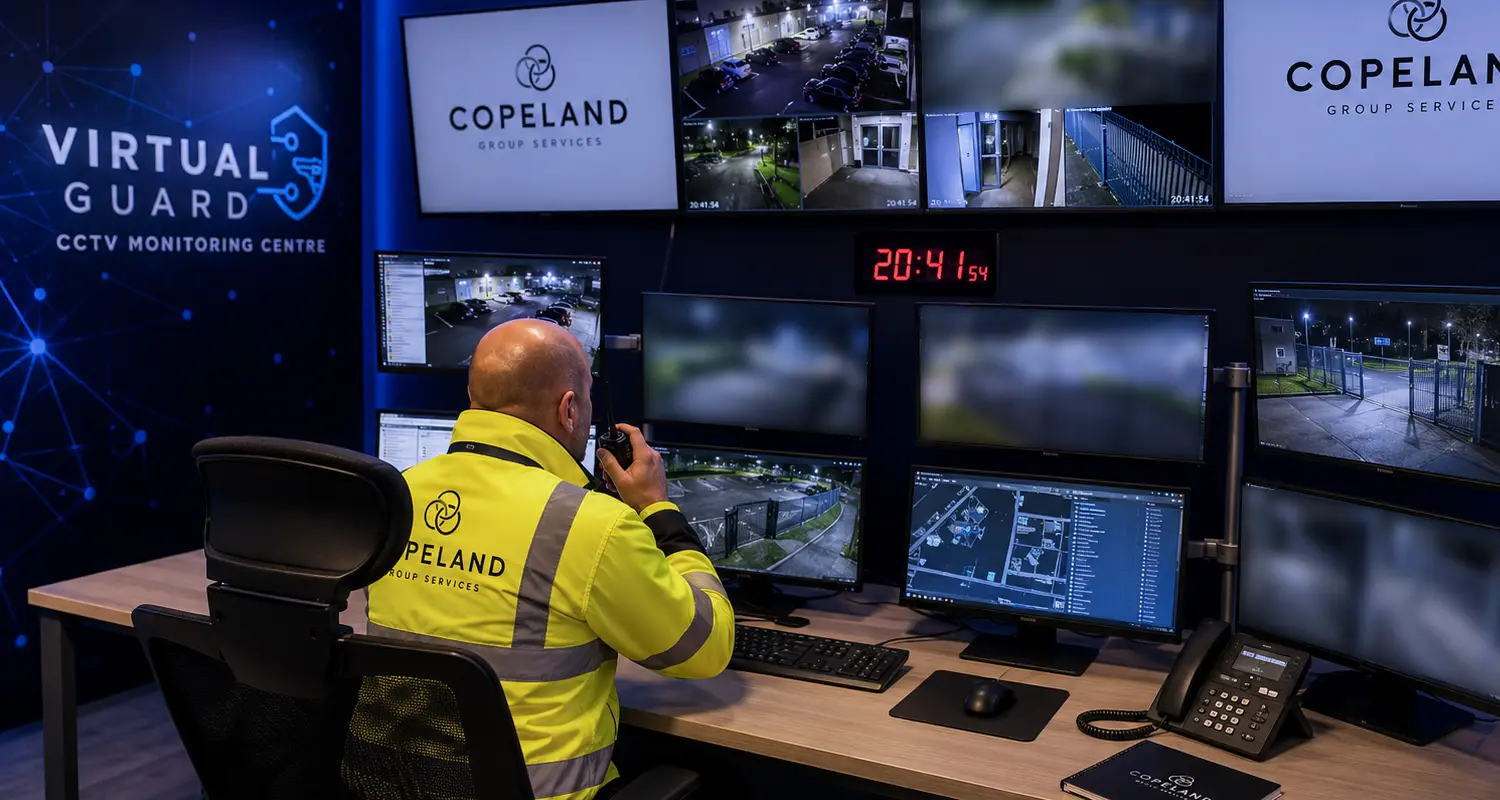
CCTV has become one of the most recognisable elements of modern security.
Walk around almost any commercial premises, industrial estate or construction site and you’ll see cameras mounted on buildings, gates and perimeter fencing. For many organisations, simply having CCTV in place provides reassurance that their site is protected.
But there is an uncomfortable truth.
CCTV doesn’t prevent crime.
It never has.
A camera records events. It may discourage opportunistic behaviour, provide evidence after an incident and help investigators understand what happened, but it cannot make decisions, challenge suspicious behaviour or respond when something is wrong.
The real value of CCTV lies in what happens next.
Recording an incident is not the same as preventing one
Imagine arriving at work to discover a break in has taken place overnight.
The CCTV system has worked perfectly. Every moment has been recorded in high definition.
The police have clear footage.
Insurance claims can be supported.
But the damage has already been done.
Equipment has been stolen.
Operations have been disrupted.
Employees arrive to find a crime scene rather than a workplace.
The footage is valuable, but it has not prevented the incident.
That distinction is becoming increasingly important as businesses review how they approach security.
The role of CCTV has evolved
Modern organisations are beginning to look beyond CCTV as simply a recording system.
Instead, they are asking a different question.
How can technology help us identify risks earlier and respond more effectively?
This is where intelligent monitoring, remote visibility and integrated security strategies begin to change the conversation.
Rather than simply collecting evidence after an event, businesses want systems that help them understand what is happening across their sites while there is still an opportunity to respond.
That is a very different objective.
Visibility creates opportunities to act
One of the greatest strengths of modern security technology is visibility.
When activity around a site can be observed, assessed and understood, organisations have the opportunity to make informed decisions before situations escalate.
A delivery arriving outside expected hours may be legitimate.
Someone entering a restricted area may not be.
A gate left open after contractors leave may simply be an oversight.
Without visibility, these situations may remain unnoticed until the following morning.
With visibility, they become opportunities to intervene.
That is why businesses are increasingly viewing CCTV as one element of a wider operational picture rather than simply a collection of cameras.
Technology still needs people
It is tempting to assume that smarter technology removes the need for people.
In reality, the opposite is often true.
Technology provides information.
People provide judgement.
A monitored system may highlight unusual activity, but experienced security professionals determine what action should be taken. They understand context, assess risk and make decisions that software alone cannot.
This relationship between technology and human expertise is where the strongest security strategies are built.
Neither replaces the other.
Together, they become significantly more effective.
Virtual Guard is about more than cameras
At Copeland Group Services, we use the term Virtual Guard to describe far more than CCTV.
Virtual Guard is our approach to intelligent remote security, bringing together permanent CCTV, EcoWatch Rapid Deployment CCTV and modern access control technologies to improve visibility across a site.
Its purpose is not simply to record events.
It is to support faster decision making, improve accountability and complement the wider security measures protecting a business.
Whether monitoring an office, warehouse, construction project or vacant property, Virtual Guard provides organisations with greater awareness of what is happening across their sites.
The strongest security strategies are connected
Businesses achieve the best outcomes when security measures work together rather than operating independently.
A professionally monitored CCTV system becomes even more valuable when combined with intelligent access control that manages who enters the building. Professional lock and unlock services ensure sites are secured consistently, while keyholding and alarm response provide trained professionals who can attend incidents without relying on managers leaving home in the middle of the night.
On larger or higher risk sites, mobile patrols and manned guarding provide additional reassurance and visible deterrence.
Each service performs a different role.
Together, they create a layered security strategy that is significantly more resilient than relying on CCTV alone.
Looking beyond the camera
Perhaps the biggest shift in modern security is changing the question.
Instead of asking:
“Do we have CCTV?”
Businesses are increasingly asking:
“What happens when the CCTV identifies a problem?”
That question moves the conversation away from hardware and towards outcomes.
Because cameras don’t protect businesses.
Well designed security strategies do.
At Copeland Group Services, we believe the most effective security solutions combine professional people, intelligent technology and consistent procedures.
Whether that’s through Virtual Guard, manned guarding, mobile patrols, professional lock and unlock services, keyholding and alarm response, access control or EcoWatch Rapid Deployment CCTV, every service plays a role in creating a stronger, layered approach to protecting people, premises and assets.
If you’d like to discuss how a blended security strategy could support your organisation, contact Copeland Group Services today.